
Passive solar home design sounds technical. The principles behind it are not. They’re observations about how sunlight moves through a building across a day and a year — and how a well-sited, well-designed home can use that movement to stay warm in winter, cool in summer, and comfortable year-round with minimal mechanical assistance. AltiHut, the solar-powered mountain retreat perched at over 3,000 meters in Georgia’s Caucasus range, offers a surprisingly practical set of lessons for anyone thinking about how their home relates to energy and environment.
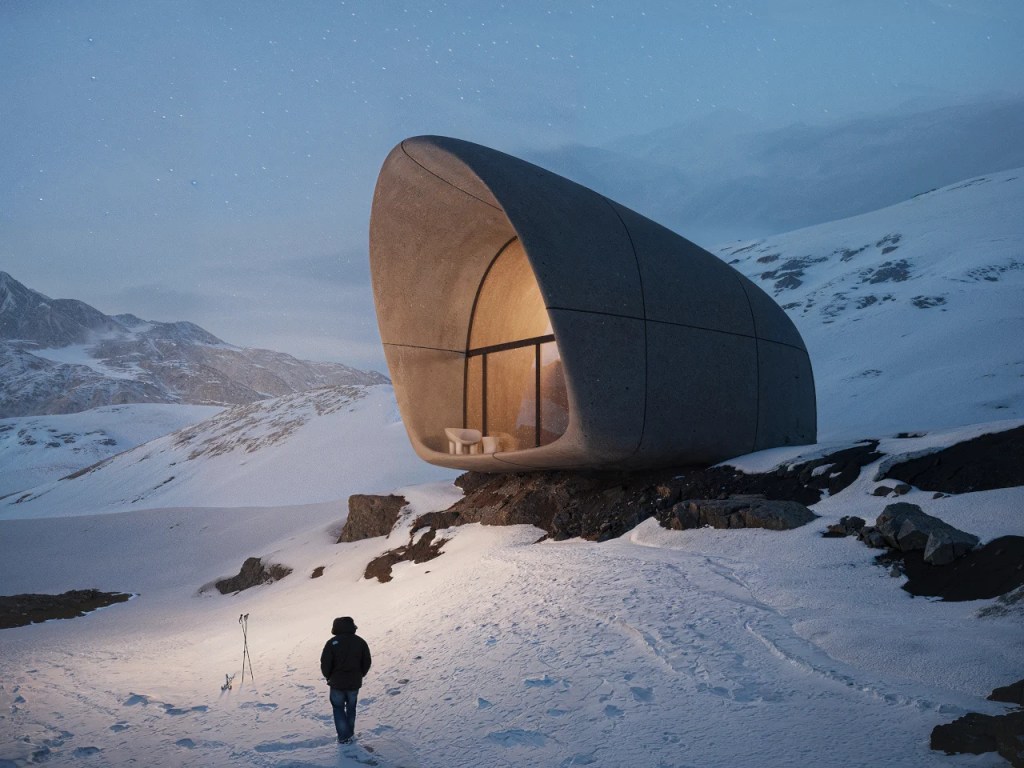
Built without road access — materials were helicoptered to the site — and powered entirely by solar panels, AltiHut had no choice but to be efficient. Constraint, as always, is a great designer. What emerged is a cabin that earns its keep entirely through thoughtful siting, orientation, and material choices. Here’s what it teaches.
“The most energy-efficient home isn’t one loaded with technology — it’s one that was designed to work with its site from the beginning.”
Lesson 1: Orientation Is Everything
AltiHut’s primary glazing faces the valley — which, at this latitude, means it faces roughly south and captures winter sun through those floor-to-ceiling glass panels all day. This is passive solar design in its purest form: no moving parts, no controls, just geometry and orientation doing the thermal work. In your own home, the single most impactful passive solar decision is window placement. South-facing glass (in the northern hemisphere) admits low winter sun and can be shaded in summer when the sun is higher in the sky.
Lesson 2: Thermal Mass Works
The fiber-concrete shell of AltiHut isn’t just structural — it’s thermal. Concrete, stone, and masonry absorb heat during the day and release it slowly overnight, smoothing out temperature swings. In a home context, a concrete floor, stone fireplace surround, or masonry wall in a sun-facing room does the same work. This is why old stone farmhouses stay cool in summer: the mass is absorbing heat rather than transmitting it.
Lesson 3: Go Small, Go Well-Insulated
AltiHut’s cottages are not large. This is intentional: a smaller volume is vastly easier to heat and cool than a large one, and encourages a more intentional relationship with space. Combined with high-performance insulation (essential at altitude), a small well-built home outperforms a large poorly-built one on every energy metric. Before adding square footage, consider what you’d gain from better insulation and air-sealing in the space you already have.
Lesson 4: Generate Where You Consume
AltiHut runs on solar panels because the grid doesn’t reach it. But the principle — generating energy at the point of consumption — is worth applying wherever you live. Rooftop solar has reached cost parity or better in most markets. Battery storage makes it increasingly viable as a primary or backup power source. The off-grid cabin isn’t an aspirational fantasy anymore; it’s a working proof of concept for the energy-independent home.
- Start with the envelope: Insulation and air-sealing before any technology
- Orient glazing south: Passive solar gains are free once baked into the design
- Add thermal mass: Stone, concrete, or brick in sun-facing rooms
- Right-size the space: Smaller, better-built beats larger, poorly-built every time
- Consider on-site generation: Solar + battery is now a realistic home energy strategy
 Whole Earth Home