
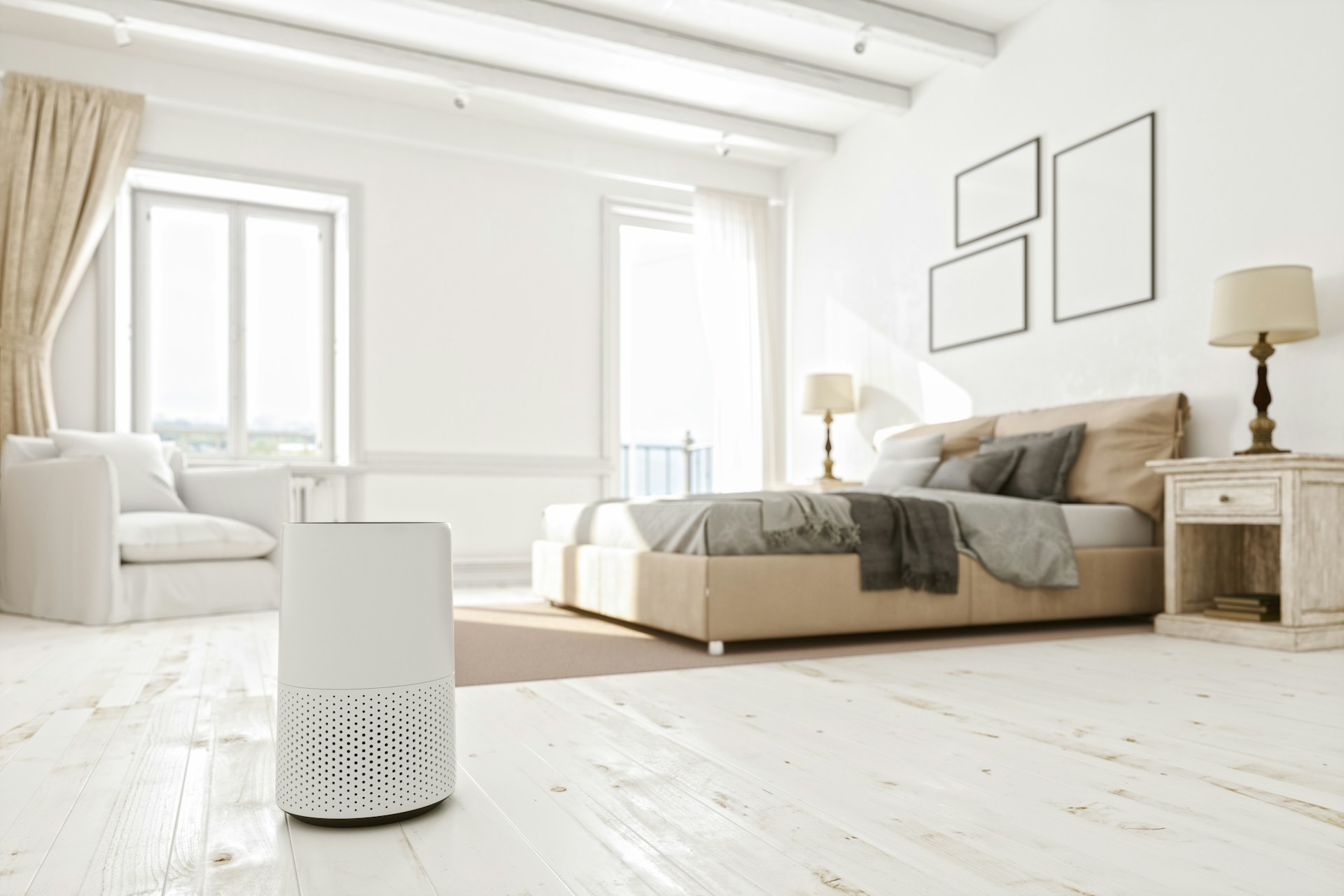
Updated October 14, 2026. Fire season is winding down for most of the country, but the house you are about to seal up for winter has an air problem of its own. Our new guide to winter indoor air covers CO2 in closed bedrooms, humidity and gas stove fumes. The purifier picks below hold up all year, and the sizing advice applies whatever the season.
If your sky has looked a little orange this week, you’re not imagining it. Smoke from wildfires burning across Canada has settled over huge stretches of the U.S., with air quality alerts active in 16 states as of this week, and the Twin Cities, Detroit, Milwaukee, and pockets of the Northeast, including a hazy, yellow-skied Boston, all reporting unhealthy conditions.

Forecasters expect the smoke to keep drifting into the Northeast and Mid-Atlantic through the end of the week, and with drought and heat feeding fire activity, this almost certainly won’t be the last smoke event of the season.

Here’s the thing: wildfire smoke doesn’t stay outside. Those same fine particles that turn the sky orange work their way indoors through doors, windows, and HVAC systems, and they’re small enough to slip past the body’s natural filters and settle deep in your lungs. Closing your windows helps, but it’s not enough on its own. The most effective thing you can do inside your own home is run an air purifier built to handle smoke specifically: not just any purifier, but one with the right filtration for both the soot particles and the gases that come with them.
We put together this list to cut through the noise: real picks, at real price points, for exactly this moment. (Smoke is only one part of your indoor air picture; see also the toxic materials still hiding in your home and what happens to your air when the windows close for winter.)
What Actually Matters When You’re Shopping for Smoke

Not every “HEPA” purifier is built the same, and wildfire smoke is a tougher problem than everyday dust or pet dander. A few things to look for before you buy:
- True HEPA (H13 or better). This is the filtration standard that captures at least 99.97% of particles down to 0.3 microns, small enough to catch the fine particulate matter (PM2.5) that makes wildfire smoke dangerous.
- An activated carbon layer. HEPA filters trap particles, but they don’t touch gases. Smoke also carries volatile organic compounds (VOCs) and that acrid campfire smell, and only an activated carbon filter will pull those out of the air.
- CADR matched to your room. The Clean Air Delivery Rate tells you how quickly a unit actually cleans a space. The rule of thumb from the industry’s testing body is a smoke CADR of at least two-thirds of the room’s square footage. Undersized units on max speed all day are noisier and less effective than a properly sized one running quietly.
- Noise level you can live with. During a multi-day smoke event, you’ll want this running around the clock, including overnight, so a low decibel rating at sleep speed matters as much as raw power.
With that in mind, here are six purifiers worth buying this week, from budget-friendly to serious, whole-house filtration.
The Best Air Purifiers for Wildfire Smoke

1. Levoit Core 300S: Best for Bedrooms & Small Spaces
A genuinely great starter purifier for anyone who just wants clean air in the room they sleep in. It pairs a true HEPA filter with an activated carbon layer, runs whisper-quiet on its sleep setting, and connects to an app so you can check air quality and adjust fan speed without getting out of bed. Ideal for bedrooms, home offices, and nurseries.
Shop the Levoit Core 300S on Amazon →

2. Coway Airmega AP-1512HH Mighty: Best Overall
We’ve personally had this one in our home for years, and it’s great.
This is the purifier that keeps showing up at the top of independent lab tests, and for good reason. It combines a true HEPA filter with an activated carbon pre-filter, adjusts fan speed automatically as air quality changes, and covers a properly sized living room or open-concept space without being obnoxiously loud. If you only buy one purifier this season, this is the safe, well-reviewed choice.
Shop the Coway Airmega AP-1512HH on Amazon →

3. Blueair Blue Pure 211+ Auto: Best for Large Rooms
Blueair’s HEPASilent technology lets this unit move a lot of air without a lot of noise, which matters when you’re covering a large living area or open floor plan. It’s built to handle big spaces efficiently, with a washable fabric pre-filter that cuts down on maintenance and an auto mode that ramps up when it senses smoke or particulate spikes.
Shop the Blueair Blue Pure 211+ Auto on Amazon →

4. Winix 5500-2: Best Value
The Winix 5500-2 has been a budget favorite for years because it doesn’t cut corners where it counts: true HEPA filtration plus a washable AOC (advanced odor control) carbon filter that’s specifically good at pulling in smoke and cooking odors. It’s an easy recommendation if you want strong performance without spending Coway or Blueair money.
Shop the Winix 5500-2 on Amazon →

5. Medify MA-40: Best Built Specifically for Smoke
Medify designed this one with wildfire smoke in mind, not as an afterthought. It uses a medical-grade H13 HEPA filter rated to remove 99.9% of particles down to 0.1 microns, smaller than the standard HEPA threshold, and is rated to cycle nearly 1,800 square feet in an hour. If your area gets hit by smoke every summer, this is the purifier that was built for exactly that problem.
Shop the Medify MA-40 on Amazon →

6. Austin Air HealthMate Plus: Best for Heavy, Ongoing Smoke Exposure
This is the option for anyone dealing with genuinely bad air on a recurring basis: wildfire-prone regions, homes near industrial areas, or households with someone who has asthma or COPD. It uses a four-stage filtration system with activated carbon and zeolite, which is particularly good at pulling in the chemical gases and odors that ride along with smoke, not just the visible particles. It’s a bigger investment, but it’s a workhorse.
Shop the Austin Air HealthMate Plus on Amazon →

Quick Comparison
| Purifier | Best For | Filtration | Coverage |
|---|---|---|---|
| Levoit Core 300S | Bedrooms, small rooms | True HEPA + carbon | ~219 sq ft optimal |
| Coway AP-1512HH | Best overall | True HEPA + carbon | ~874 sq ft optimal |
| Blueair 211+ Auto | Large rooms | HEPASilent + carbon | ~1,000+ sq ft |
| Winix 5500-2 | Best value | True HEPA + AOC carbon | ~360 sq ft optimal |
| Medify MA-40 | Purpose-built for smoke | H13 HEPA + carbon | ~1,793 sq ft/hr |
| Austin Air HealthMate Plus | Heavy, ongoing exposure | HEPA + carbon + zeolite | ~1,500 sq ft |
A Few Tips for Getting Through a Smoke Event
- Close up the house. Windows, doors, and if you can manage it, set your HVAC system to recirculate rather than pull in outside air.
- Run it continuously, not just when it smells smoky. The particles that matter most (PM2.5) are often invisible and odorless well before you can smell smoke.
- Size up, not down. When in doubt, choose the purifier rated for a larger room than the one you’re placing it in; it will run quieter on a lower setting instead of straining on high.
- In a pinch, a DIY box fan filter works. If a smoke event catches you without a purifier on hand, a box fan taped to a furnace filter (sometimes called a Corsi-Rosenthal box) is a genuinely effective, inexpensive stopgap while you wait for a proper unit to arrive.
- Check filters more often during smoke season. Heavy smoke clogs filters faster than normal household dust. If your air quality readout stops improving, it’s usually a filter, not the machine.
WHOLE EARTH PICK · THE STOPGAP
Build a Corsi-Rosenthal Box
Four MERV 13 furnace filters taped into a cube, a 20-inch box fan on top blowing upward, and a square of cardboard to seal the bottom. It takes about an hour, costs a fraction of a purifier, and the fan’s square frame makes the build easy.
More on making your home healthier: Healthy Home · The winter indoor air problem · The fall cleaning checklist · The sustainable home upgrades most people overlook · All our buying guides
Browse our full list of favorite home and air-quality picks on our Amazon storefront.
Whole Earth Home is a participant in the Amazon Services LLC Associates Program. Links in this post are affiliate links, and we may earn a small commission on qualifying purchases at no extra cost to you.
2 responses to “Wildfire Smoke Is Back: The Air Purifiers That Actually Help Right Now”
[…] going: The toxic materials still hiding in your home · The air purifiers that actually help · Healthy […]
[…] on making your home healthier: Healthy Home · The toxic materials still hiding in your home · The air purifiers that actually help · 7 eco upgrades that save you […]