
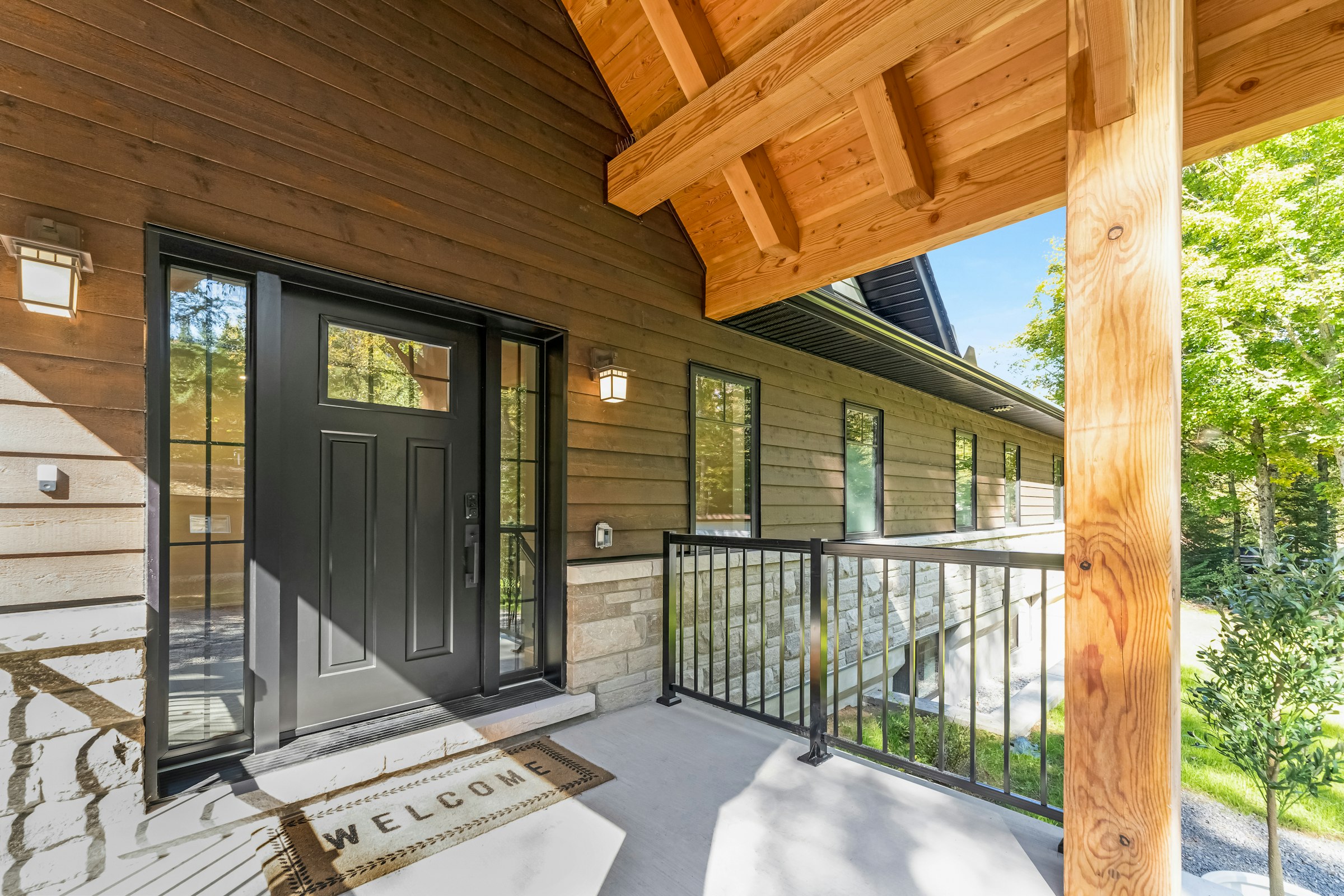
The front of a house is the part everyone else lives with. The neighbors walk past it, the delivery driver squints at it after dark, and the bees and birds decide whether it’s worth a stop. It’s also where a surprising amount of a home’s water, light and heat quietly slips away.
We think the porch and the front yard deserve the same care as the kitchen. A warm light that points down, a door that seals, a little less lawn, a tree in the right spot and a place to sit. None of it is expensive, and all of it makes a house look glad you came home.
Shopping links in this guide are affiliate links, and we may earn a small commission at no extra cost to you. We choose every pick on our own.
The short version
- Light the porch warm, low and only when someone needs it. Point it down, not out.
- Seal the front door. If you can see daylight under it, add a sweep.
- The average household uses more water outdoors than for showers and laundry combined. Trading some lawn for native plants is the biggest fix.
- Leave the leaves in the beds this fall, and send a downspout to a rain barrel or rain garden.
1. Light it warm and point it down

DarkSky International, the group that has spent decades fighting light pollution, boils good outdoor lighting down to five principles: light should be useful, targeted, low level, controlled and warm-colored. On a porch that means lighting only what you need (the steps, the lock, the house number), aiming it down with a shielded fixture so it doesn’t glare into the street or the sky, keeping it no brighter than it needs to be, putting it on a motion sensor or timer, and choosing a warm bulb.
For warm, check the color temperature on the box. We go with 2700K, the soft white of an old incandescent bulb, and never above 3000K. DarkSky asks us to keep bluer, shorter-wavelength light to a minimum, and the warm end of the box gets you there. Whatever you choose, make it LED. The Department of Energy says residential LEDs, especially ENERGY STAR ones, use at least 75% less energy and last up to 25 times longer than incandescent bulbs. Shopping for a new fixture? Look for the DarkSky Approved seal or a fully shielded design.
For the porch fixture
Feit Electric 2700K dusk-to-dawn LED bulbs
A warm 2700K LED with a built-in light sensor that switches itself on at dusk and off at dawn, plus high color rendering, so the porch looks like itself after dark. It’s the right bulb for a light that has to burn all night. If yours doesn’t, a motion sensor keeps the street darker still. Sensor bulbs need to see daylight, so they work best in open or clear-glass fixtures.
2. Make the front door seal
A front door takes a beating, and its weatherstripping goes flat long before the door wears out. Close the door on a sheet of paper. If it slides out without a tug, the seal isn’t doing its job. If you can see daylight at the bottom, add a door sweep. Both jobs take an afternoon, and the entry stops feeling like a wind tunnel in January.
For the doormat
Natural coco coir doormat
A full inch of stiff coconut fiber that scrapes grit, leaves and mud off shoes before they reach the floors. Coir is a natural byproduct of coconut harvesting and lasts for years outdoors. Keep it under the porch roof where it can dry out between storms. Check the back before you buy: many coir mats have a vinyl backing, which is fine on a porch but won’t go in the compost.
Then find the drafts you can’t see. Pick a breezy day and work your way around the door frame, the mail slot and the sidelights.
3. Trade some lawn for natives
Here’s the number that surprises people. The EPA’s WaterSense program says the average American household uses more water outdoors than for showering and washing clothes combined, and that residential outdoor water use across the country comes to nearly 8 billion gallons a day. Most of it goes on lawns and landscaping.

The front yard is a fine place to shrink that number. Native plants are adapted to your local rain and soil, so once they’re established they usually need much less watering than turf, and they feed the pollinators and birds a lawn can’t. Start at the edges: a deep bed along the front walk, a pollinator strip by the street, a ring of natives under the tree. Your state’s native plant society or extension service will have lists for your region, and the EPA’s What to Plant tool is a good start. If you have an HOA, check the rules before the sod comes up.
By the numbers
8 billion
gallons of water a day go to residential outdoor use in the U.S.
The average household uses more water outdoors than for showers and laundry combined.
4. Leave the leaves in the beds
Fall cleanup is where a lot of front yards go wrong. Rake the leaves off the lawn and the walk, by all means, but tuck them into the beds instead of bagging them. They break down into free mulch and shelter the insects that spend the winter there. Leave the seed heads standing, too; the birds will thank you. We made the full case for doing less in The Lazy Autumn Reset.
5. Plant shade where it counts
A tree in the right spot is the hardest-working thing in a front yard. The Department of Energy’s landscaping guide suggests tall deciduous trees with high, spreading branches on the south side of a house to shade the roof in summer, and trees with lower branches on the west side to block the low afternoon sun. Deciduous trees drop their leaves in fall, so the winter sun still gets through. DOE also notes that simply shading an air conditioner can raise its efficiency by as much as 10%.
Plant for the grown-up tree, not the one in the pot: its full height, its spread, and the power lines, sidewalk and foundation it will eventually meet. And call 811 a few days before you dig, so the utility lines get marked.
6. Catch the rain

Every roof is a rain collector. Instead of sending that water down the driveway into the storm drain, slow it down. A rain barrel under a downspout saves water for dry spells. A rain garden goes further. The EPA describes it as a shallow, planted dip that collects rain water from a roof, driveway or street and lets it soak into the ground, filtering pollutants along the way and giving butterflies and songbirds a place to land.
Keep a rain garden well away from the foundation (your local guide will give a distance), find out where the utilities run before you dig, and plant it with native grasses and flowering perennials that can take both wet feet and dry spells. A few places regulate rain barrels, so check your local rules, too.
For the downspout
Step2 Lakewood 60-gallon rain barrel
A big barrel on its own stand, which lifts the spigot high enough to fill a watering can. It’s plastic, which we’d usually steer around, but a rain barrel is one place where a tough, sealed container earns its keep for years. Keep it covered and screened so mosquitoes can’t breed in it, and drain it before a hard freeze.
7. Make it a place to sit

The best porches get used. A chair or a bench by the door turns the front of the house into a place for morning coffee, a wave to the neighbors and watching the weather roll in. It’s also how a street starts to feel like a neighborhood!
Buy porch furniture once. Look for solid wood with a forestry certification such as FSC, or furniture made from recycled plastic lumber, which shrugs off rain and never needs paint. Add a planter or two of natives and a house number big enough to read from the street at night, and the front of the house is done.
Swap this for that
| Instead of | Try | Why it is better |
|---|---|---|
| A cool white floodlight | A shielded fixture with a warm 2700K LED | Less glare, darker skies |
| A light that burns all night | A motion sensor or timer | Light only when someone is there |
| A worn door seal | New weatherstripping and a sweep | A warmer, quieter entry |
| A front yard of lawn | Native beds along the edges | Less watering, more pollinators |
| Bagging every leaf | Tucking leaves into the beds | Free mulch and winter shelter |
| Downspouts onto the driveway | A rain barrel or rain garden | Water soaks in instead of running off |
FAQ
What color porch light is best?
Warm. We use 2700K and wouldn’t go above 3000K, in a shielded fixture that points down, on a motion sensor or timer. That covers four of DarkSky’s five principles in one fixture.
Do warm porch lights attract fewer bugs?
Many night-flying insects are drawn most to bluer light, so a warm bulb and a light that’s off most of the night is the bug-friendly setup. No bulb is invisible to insects, though. Less light, for less time, does the most.
Do I have to tear out the whole lawn?
Not at all. Start with the edges and the spots that are hard to mow or water, and keep the patch of grass you actually use. Every square foot of natives is a square foot you don’t have to water all summer.
Will a rain barrel breed mosquitoes?
Only if they can get in. Keep the lid on, screen the inlet, and use the water regularly so it doesn’t sit for weeks.
More from around the house: Fall is compost season · The lazy autumn reset · Cut your heating bill for under $100 · The vegetables that get sweeter after a frost
Product details come from each maker and its Amazon listing as of November 2026; listings change. Sources: DarkSky International lighting principles; U.S. Department of Energy Energy Saver (LED lighting) and its landscaping guide; U.S. EPA WaterSense and Soak Up the Rain; the Xerces Society. Whole Earth Home is a participant in the Amazon Services LLC Associates Program. Shopping links in this post are affiliate links, and we may earn a small commission on qualifying purchases at no extra cost to you.